Objective
Since we are interested in predictive simulations of the unstart phenomenon caused by thermal choking, the heat release model is central to our overall objectives. The heat release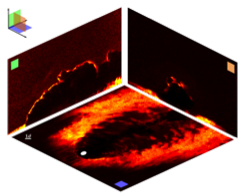 modeling group is focusing on the development of heat release models for supersonic combustion to be used in both low and high fidelity simulations. We are also interested in identifying and characterizing all uncertainties associated with the combustion process. The group effort relies on a close interaction between experimental and numerical work. In particular, two in-house experiments directly support the modeling effort, i.e., a mixing and combustion of a jet in supersonic cross-flow experiment and shock tube experiments to characterize the different reaction rates and their uncertainties.
Our specific goals are:
- Develop low fidelity combustion model for full system simulations (RANS)
- Develop high fidelity combustion model for both low and high fidelity simulations (RANS/LES)
- Validate models with support of experimental work
- Identify and characterize uncertainties in combustion
People
| Name | Email address | Focus |
| Prof. Heinz Pitsch | h.pitsch@stanford.edu | Combustion modeling |
| Prof. Godfrey Mungal | mungal@stanford.edu | Experimental investigation of combustion and mixing |
| Prof. Ron Hanson | rkhanson@stanford.edu | Shock tube experiments |
| Dr. David Davidson | dfd@stanford.edu | Shock tube experiments, characterization of reaction rates, chemical mechanism |
| Dr. Vincent E. Terrapon | terrapon@stanford.edu | Combustion and mixing modeling (LES/RANS) |
| Dr. Mirko Gamba | mirkog@stanford.edu | Experimental investigation of combustion and mixing in JICF |
| Amirreza Saghafian | saghafian@stanford.edu | LES of combustion in JICF |
| Victor A. Miller | vamiller@stanford.edu | Experimental investigation of model scramjet combustor Acetone/toluene PLIF in expansion tube flows |
| Christopher L. Strand | cstrand@stanford.edu | TDL-based thermometry and velocimetry in hypersonic flows |
| Zekai Hong | hongzk@stanford.edu | Kinetics |
| Jon Yoo | jhyoo@stanford.edu | Imaging |
Approach
Our approach relies on a close collaboration between experimental and numerical studies. This means not only that experimental measurements are used for code validation, but also that numerical results provide information on how to shape the experiments. Concretely, this means:
- Experimental configurations and conditions are well characterized; in particular, uncertainties are quantified and prioritized.
- Numerical validations provide flexible parameter study, insight in quantities not easily measured, recommendations on improvements of the experiments.
Experimental work
Two sets of experiments are currently being carried out in support of the supersonic combustion modeling efforts:
H2/O2 Kinetics (Prof. Hanson)
The development of a high-fidelity H2/O2 kinetic mechanism from accurate reaction rate measurements in shock tubes is in direct support to the modeling approach being developed for high-speed supersonic combustion (see further below for details). It is designed to improve our understanding and description of reaction rates for hydrogen chemistry using state-of-the-art, highly-accurate, H2O laser-absorption-based measurement techniques in shock tubes. The end goal of this work is to develop a refined and improved H2/O2 kinetics mechanism with a solid understanding of the source and levels of uncertainty in the proposed reaction rates, and their impact on the predictive capability of the resulting combustion model.Reactive transverse jet in supersonic crossflow (Prof. Mungal)
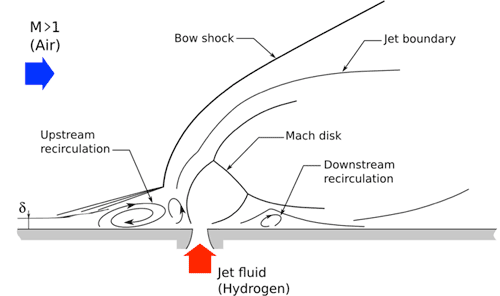
The investigation of mixing, ignition and reaction zone structure in transverse hydrogen jets in supersonic crossflows is primarily designed as a validation test case for the supersonic mixing and combustion models developed within the center, for both RANS and LES solvers. The system being considered is a hydrogen jet injected normal to an incoming supersonic crossflow from a flat plate (JICF). The work is carried out in an expansion tube where the aerothermodynamic conditions typically found in scramjet combustors of interest in our center are replicated, effectively providing a direct test and validation case within the range of validity of the developed combustion model. JICF is a fundamental canonical flow of relative simplicity but that retains many flow features of interest for model validation purposes (such as three-dimensionality, separation and recirculation regions, wall-bounded effects, and vortical flows). Furthermore, a JICF maintains some level of practical relevance as fuel delivery strategy in scramjet propulsion technology. Current work focuses on investigating ignition and flame structure (primarily based on OH planar laser-induced fluorescence imaging) of hydrogen JICF and the effects of conditions of operations (such as the value of momentum flux ratio) on such characteristics. Future work will address supersonic mixing under similar aerothermal conditions.
Modeling (Prof. Pitsch)
The modeling of the mixing and heat release within the combustor is performed at different fidelity levels:1D heat release model
While the 1D heat release model used in RANS simulations is rather crude, it captures some of the key physical aspects involved in supersonic combustion. Its low computational cost allows a large number of simulations to be performed, which is a requirement for complex UQ studies. This model focuses on the heat release itself and does not include any details of the combustion.Mixing
Because mixing is central to combustion, particularly in high-speed flows, a specific effort also focuses on its physical and modeling aspects. LES studies are performed to understand the physics and to develop more accurate models for RANS simulations.FPVA-based model
Finally, a more accurate combustion model is also being developed for both low and high fidelity simulations, i.e., RANS and LES respectively. This model is based on tabulated chemistry similar to the Flamelet/Progress Variable Approach (FPVA). It allows the use of complex chemistry, which can involve a large number of species. Because more physics is included in the model, the model-form uncertainties are thus decreased. This is however at the expense of computational cost.Additional details can be found in the following CTR brief:
Results
Preliminary experimental and numerical results:
H2/O2 Kinetics
Temperature imaging of shock wave flows
Jet in supersonic crossflow
- Schlieren visualization: Schlieren images of hydrogen (sonic) jet injected normal to a supersonic crossflow.
- OH* chemiluminescence visualization: Images of OH* chemiluminescence of hydrogen (sonic) jet injected normal to a supersonic crossflow.
- OH-PLIF visualization: Images of planar laser-induced fluorescence of OH radical in hydrogen (sonic) jet injected normal to a supersonic crossflow. The flat plate model is used in these experiments. Different momentum flux ratios, J, are considered. Imaging is carried out on several side-planes along the length of the plate.
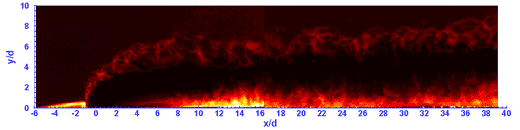
- Comparison between experiment and simulation
HyShot II
- RANS results with high-fidelity combustion model